Düsseldorf

City guide

Düsseldorf

A Rhine capital where elegance meets easy living.

At a glance

Düsseldorf wears its sophistication lightly. The Rhine cuts through the center, the Altstadt packs its famous thousand-bar 'longest bar in the world' into a few medieval streets, and a kilometre north the Medienhafen stacks Frank Gehry's leaning towers against glass and steel. It is the state capital of North Rhine-Westphalia, a long-standing hub for fashion, advertising, and Japanese business — and, almost stubbornly, a livable city.

Unlike Berlin or Munich, Düsseldorf is compact and walkable. You can cross it on a bicycle in half an hour. Each Stadtteil carries its own character — patrician, bohemian, village-quiet, or just-turned-cool — and the Rhine ties them all together. A ten-minute tram takes you from Art Nouveau villas to street-art alleys, from Michelin stars to a €2 Altbier in a wood-panelled Brauhaus.

For anyone moving here — for a trade fair, a new job with one of the city's DAX-listed employers, or simply for a quieter life along the Rhine — choosing the right neighbourhood matters more than the square metres on paper. Here is where to look.

Neighborhoods to know

Four corners of the city, each with its own rhythm.

Oberkassel
Düsseldorf

Oberkassel

Leafy, refined, left of the Rhine

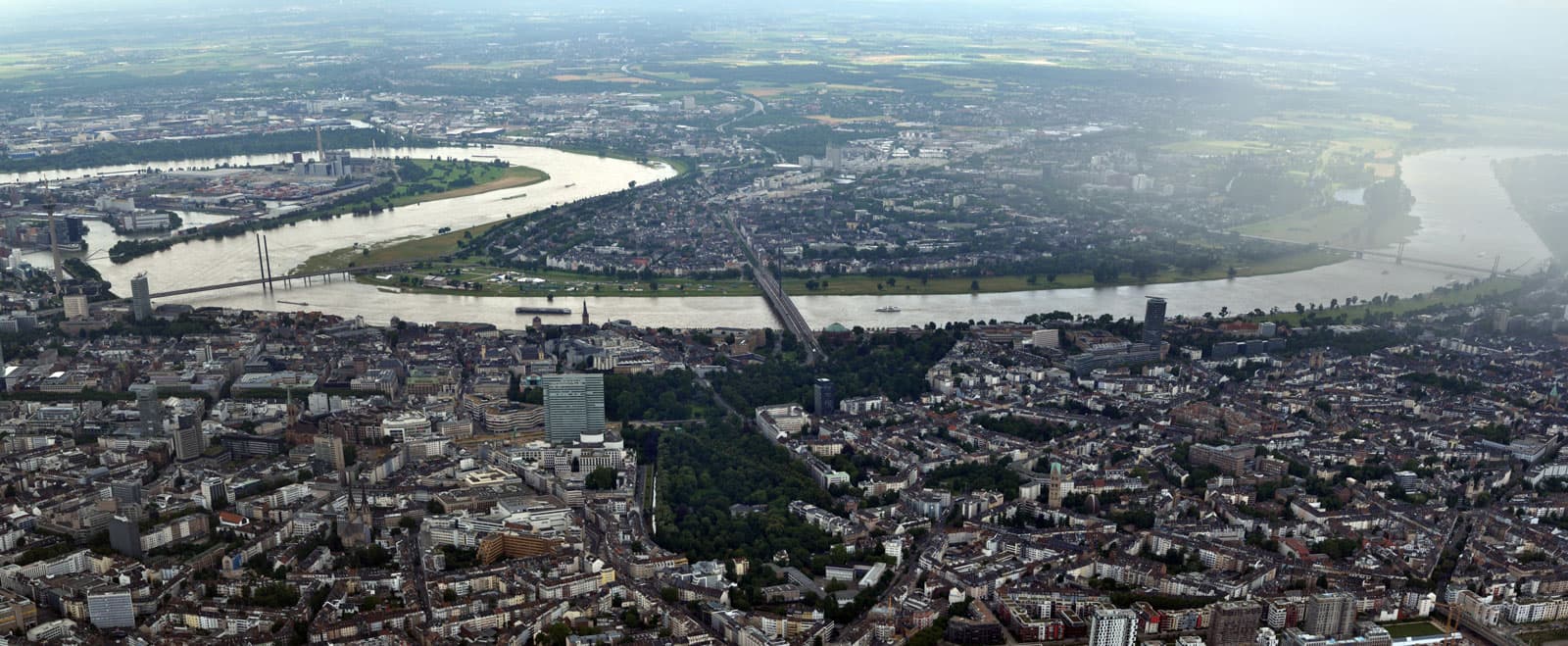
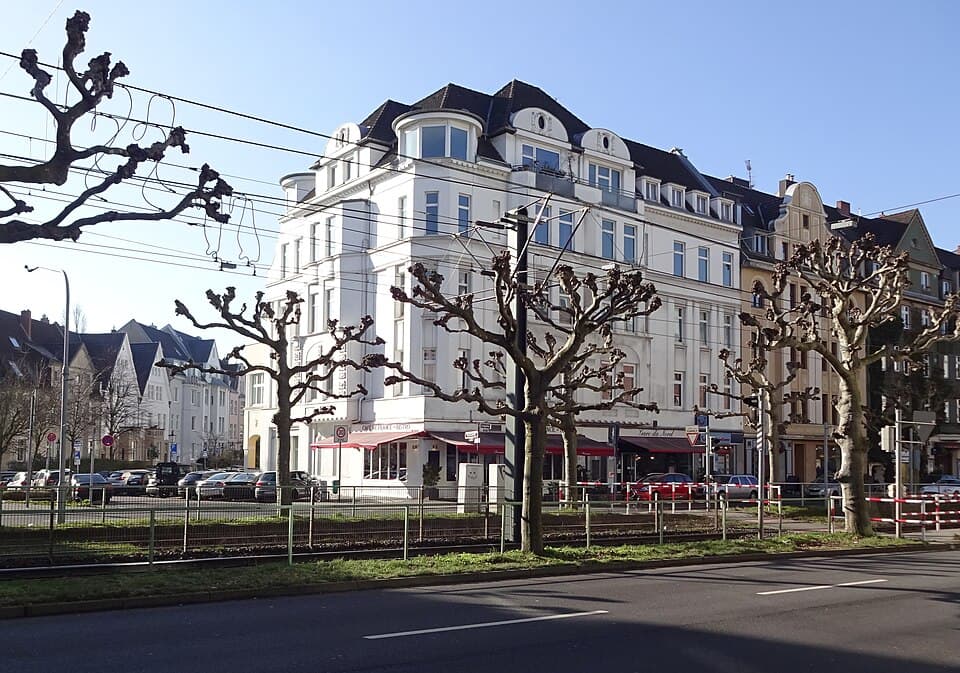
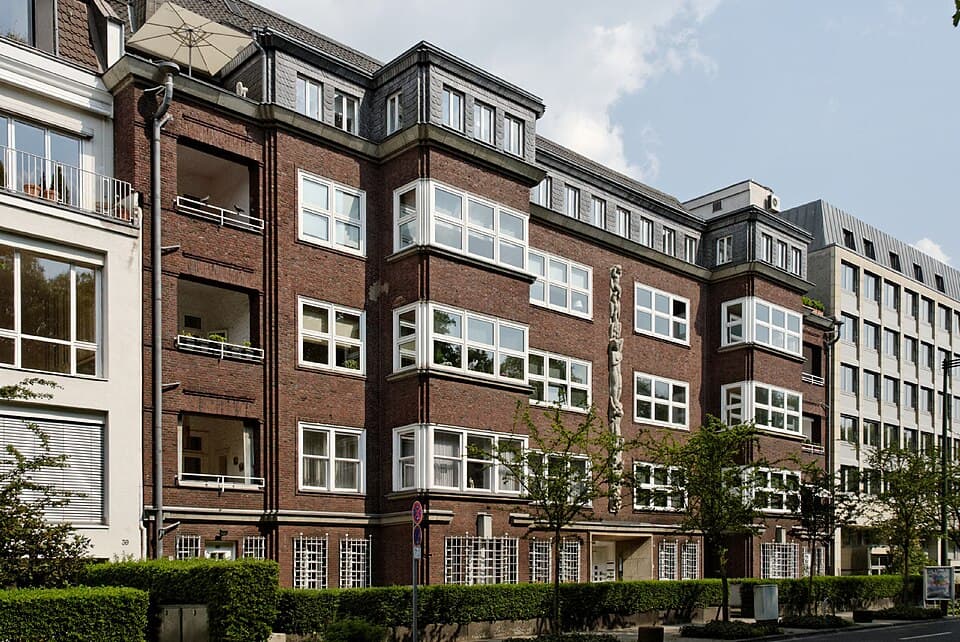
Cross the Rheinknie bridge from the city centre and the rhythm changes. Oberkassel sits on the left bank in a grid of wide, tree-lined boulevards, with Luegallee as its slow-moving spine. The buildings are overwhelmingly Gründerzeit and Art Nouveau — stucco façades, high ceilings, parquet floors that creak in the best way. At dusk, the riverside promenade offers what may be the most photographed view in the city: the full sweep of the Altstadt skyline, church spires and Schlossturm catching the last of the light.

Who lives here

Established families, media and advertising professionals, and expats who want quiet mornings and a short tram ride to the Königsallee. It is not cheap, and it does not pretend to be.

Highlights

  • Luegallee: cafés, Italian delis, independent bookshops, and the Saturday-morning Wochenmarkt
  • Riverside promenade with unobstructed views of the Altstadt skyline
  • Jugendstil villas, stucco ceilings, high-quality renovations throughout
  • The U74 and U75 reach the Altstadt in under ten minutes
Search flatsOberkassel
Golzheim
Düsseldorf

Golzheim

The diplomatic quarter on the river

North of the city centre, where the Rhine bends and widens, Golzheim is one of Düsseldorf's most understated addresses. Embassies and consulates line its quieter streets; the architecture ranges from stately 1920s Bauhaus villas to discreet postwar modernism. The Nordpark — with one of the finest Japanese gardens in Europe — sits at its northern edge, along with the Rheinterrasse for summer-evening drinks.

Who lives here

People who like their neighbourhoods calm but connected. A favourite of Japanese families — Düsseldorf has Europe's third-largest Japanese community, and Golzheim is part of why.

Highlights

  • Nordpark and its Japanese Garden — 36 hectares of formal lawns, sculpture, and tea houses
  • Rheinterrasse: a Bauhaus-era riverside restaurant and event pavilion
  • Walking distance to the Messe, the Aquazoo-Löbbecke Museum, and the Japanese quarter along Immermannstraße
  • U78 and U79 link the district directly to the city centre and the airport
Search flatsGolzheim
Kaiserswerth
Düsseldorf

Kaiserswerth

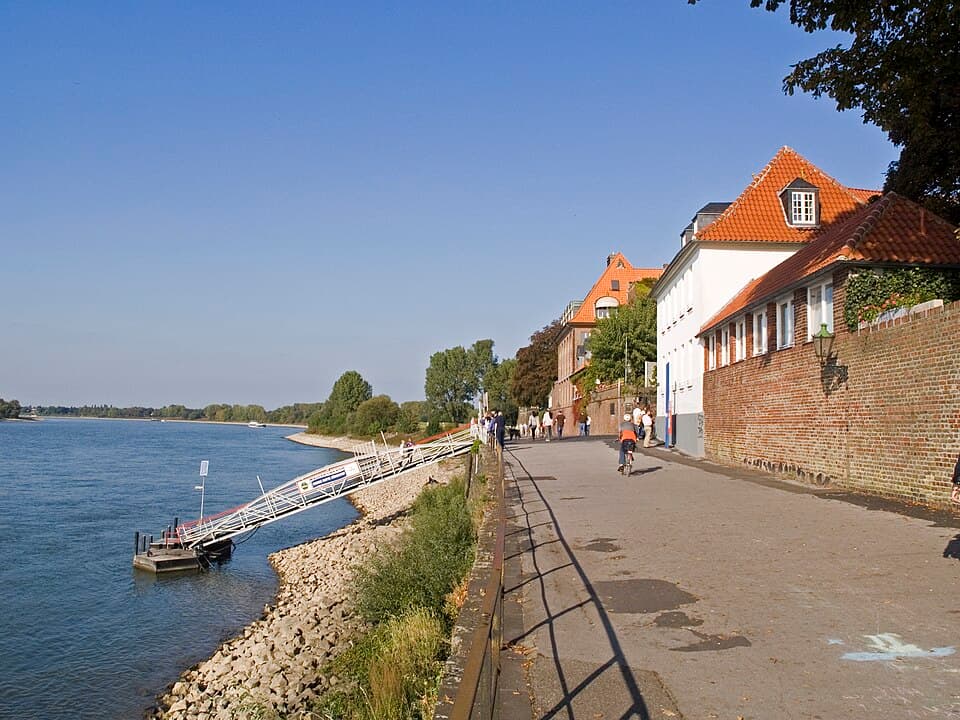
A medieval village on the Rhine's edge

Kaiserswerth is the oldest quarter of Düsseldorf — older than the city itself. Originally an 8th-century monastic settlement, then an imperial Pfalz whose brick ruins still line the riverbank. The centre is a pedestrianised cluster of cobblestones, baroque townhouses, and a working harbour where a ferry crosses the Rhine on a rope. Florence Nightingale trained nursing here in the 1850s; the deaconess tradition is still part of its identity.

Who lives here

Families and those who prize heritage, riverfront walks, and Sunday breakfast in a café that has been there for two hundred years. Twenty minutes from the Altstadt, but it feels, frankly, like a village.

Highlights

  • Kaiserpfalz ruins: the riverside brick shell of Barbarossa's imperial palace
  • Baroque market square anchored by the Basilica of St. Suitbertus
  • Rhine ferry to Langst-Kierst — a five-minute crossing into open countryside
  • U79 direct to the Altstadt and the main station
Search flatsKaiserswerth
Medienhafen
Düsseldorf

Medienhafen

Where Gehry meets the Rhine

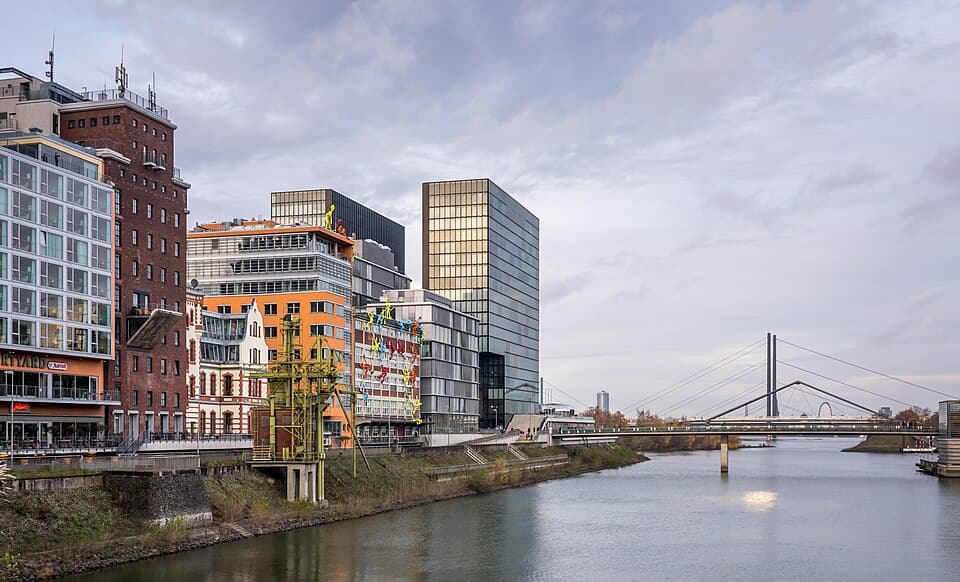
Where the Rhine curves past the southern edge of the Altstadt, the old industrial harbour has been reinvented as the city's most photographed stretch of architecture. Frank Gehry's Neuer Zollhof — three sculptural towers in white plaster, brick-red, and polished stainless steel — anchors a skyline that now also carries work by David Chipperfield, Steven Holl, and Claude Vasconi. Cargo cranes still stand as monuments; warehouses have become agencies, loft apartments, and restaurants whose terraces look across the water to the Rheinturm.

Who lives here

Creative professionals, media executives, architects, and anyone who wants to live inside a postcard of contemporary architecture. Flats here are newer, higher-spec, often with floor-to-ceiling windows and Rhine views — and the prices reflect it.

Highlights

  • Neuer Zollhof: Gehry's three leaning towers, the most-photographed address in the city
  • Rheinturm: a 240-metre observation tower with a revolving restaurant at the top
  • Restaurants and bars lining the Speditionstraße and Hafenbecken waterfront
  • Ten minutes on foot to the Altstadt and the Königsallee
Search flatsMedienhafen

Find your flat in Düsseldorf

Browse furnished flats across the city's most sought-after neighbourhoods.

Search flats